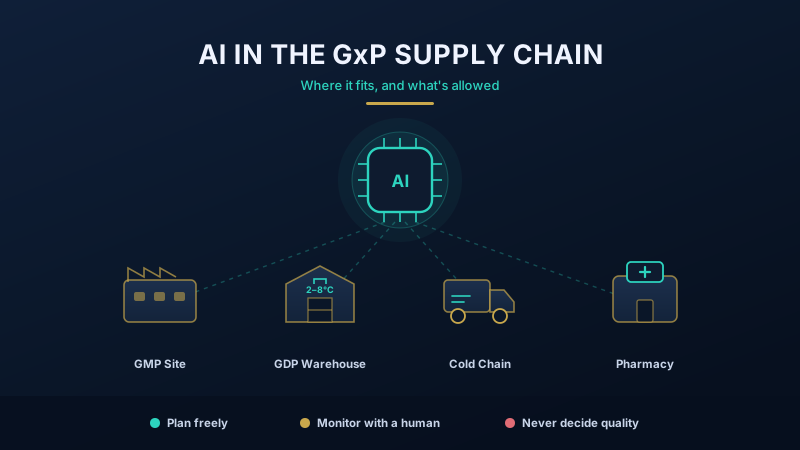
Every pharma and medtech supply chain team in Ireland is asking the same question: where can we actually use AI? The quality team's reflex is to say nowhere, because our systems are validated. The truth is simpler and more useful. AI is allowed in most of the supply chain. You just need to know which parts.
Where AI Fits, Stage by Stage
Follow a product from planning to the pharmacy shelf and the picture becomes clear. The further you are from product quality decisions, the freer you are to use AI.
A Closer Look at Each Stage
1. Plan: the open playground
Planning is where AI earns its keep fastest, because nothing here touches a regulated record. A model that forecasts demand across your European markets, simulates safety stock levels or predicts which SKUs will go short next quarter works on business data, not batch data. If the forecast is wrong, you carry extra stock or expedite a shipment. Nobody's licence is at risk. Start here, prove the value, and build trust with your quality team before going anywhere near the regulated stages.
2. Source: AI points, people decide
Supplier management is full of pattern-recognition work that AI does well. A model can scan delivery performance, quality complaints and audit history to score which suppliers are drifting towards trouble, so your auditors spend their time where the risk actually is. The line to hold: the model feeds the requalification schedule, it never owns it. The decision to approve, audit or delist a supplier stays with a person, and the audit trail must show that person's call.
3. Make and release: the hard boundary
Inside the four walls of a GMP site, AI can still help the supply chain. Predicting equipment failures before they stop a line, spotting unusual patterns in yield, flagging a batch record that looks like it will delay release. All of that supports people doing their jobs. What AI can never do is make the release decision itself. EU law places batch certification personally on the Qualified Person, and that duty cannot be delegated to software of any kind. This is the one place in the chain where the answer is simply no.
4. Store: the watchful eye
A GDP warehouse generates exactly the kind of data AI loves: thousands of temperature readings, door events and movement logs every day. A model watching that stream will spot a failing chiller or an odd cooling pattern hours before a threshold alarm fires. The discipline is the same as sourcing: the model raises its hand, and a person decides whether it becomes a recorded excursion. Let the AI watch all night, and keep the decision on a human desk in the morning.
5. Distribute: free roads, guarded records
Distribution splits neatly in two. Route optimisation, carrier selection and ETA prediction on lanes out of Dublin Port or Shannon are fair game, no different from any other logistics business. Serialization is the other half. When a pack fails verification under the Falsified Medicines Directive, AI can triage the exception and suggest the likely root cause, which saves hours across thousands of events. But closing that exception writes to a regulated record, so the confirmation belongs to a person.
The Three Rules That Keep You Compliant
Whatever the use case, the same three rules apply across the chain. They come straight from GAMP 5, EMA's AI guidance and the EU AI Act, but you don't need to read a single page of them to remember this:
Start Here
- Start in planning. Forecasting and inventory work delivers real value with zero validation overhead.
- Move to monitoring. Cold chain alerts and supplier risk scoring, always with a person making the call.
- Leave quality decisions alone. Batch release belongs to the Qualified Person, and no model changes that.
GxP doesn't forbid AI in the supply chain. It forbids AI that nobody locked, nobody supervises and nobody controls.
Scoping an AI use case in your supply chain and not sure which stage or tier it lands in? Get in touch, it's usually a one-conversation answer.
References
- EU AI Act (Regulation 2024/1689) and its implementation timeline
- EMA reflection paper on AI in the medicinal product lifecycle
- ISPE GAMP 5 Guide, Second Edition (AI/ML appendix)
- HPRA, Ireland's regulator for medicines and medical devices