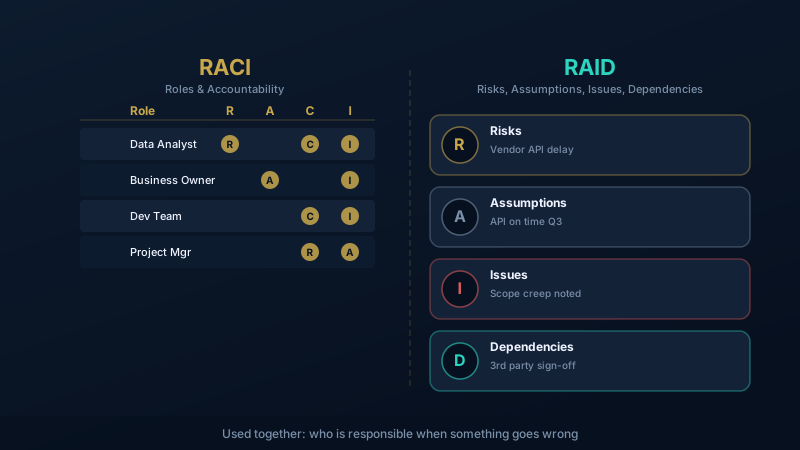
When I started working on projects early in my career, I used to hear people say things like "Add it to the RAID log" or "Check the RACI for that." I nodded along, pretending I knew exactly what they meant. Both terms sounded important but also confusingly similar. It took me a few projects to really understand what each one does and why they matter so much. Today, I use RACI and RAID in almost every project I am involved in, and they have become two of my favourite tools for bringing structure, ownership, and clarity to the work.
What Is RACI?
RACI is a simple framework that helps everyone know who is doing what. It stands for:
- Responsible — the person doing the actual work
- Accountable — the person who owns the outcome or final decision
- Consulted — those whose opinions are sought before a decision
- Informed — those who need to know what is happening
It sounds simple, but when you are in the middle of a busy project with multiple stakeholders, this clarity is invaluable.
I once worked on a third-party logistics onboarding project for a medtech organisation where both the Finance team and the subject matter expert thought they were responsible for approving the final data flows. The result was two teams giving conflicting feedback, deadlines slipping, and nobody sure whose word was final. Once we built a RACI matrix, it all became clear: the Finance stakeholder was Accountable, the Data Analyst was Responsible, and everyone else was either Consulted or Informed. From that point on, collaboration became much smoother.
That is the beauty of RACI: it removes the grey areas.
What Is RAID?
RAID is a completely different tool that serves a different purpose. It stands for:
- Risks — things that could go wrong
- Assumptions — things you believe are true but have not confirmed yet
- Issues — things that have already gone wrong
- Dependencies — things or people your project relies on
A RAID log is your project's health check. It helps you stay ahead of problems before they become roadblocks.
I once managed a system integration project that depended heavily on a third-party vendor delivering an API on time. We added that to the Dependencies section of our RAID log and reviewed it weekly. When the vendor's timeline slipped, we already had a mitigation plan ready. That early visibility saved the project from a much larger delay.
How RACI and RAID Work Together
I like to think of RACI and RAID as two sides of the same coin.
- RACI tells you who is responsible when something happens.
- RAID tells you what is happening: the risks, assumptions, issues, and dependencies affecting your project.
When a risk turns into an issue, your RACI matrix already tells you who is accountable for fixing it, who needs to be consulted, and who should be informed. That clarity speeds up decision-making and reduces finger-pointing.
Put simply: RACI defines people and roles. RAID tracks problems and risks. Together they create transparency, structure, and alignment.
Real Value in Practice
Most projects fail not because of bad ideas, but because of poor communication. People assume others are handling something, risks go untracked, or issues go unnoticed until it is too late. That is where these tools shine.
They are not complicated or overly technical. They are simple frameworks that make teamwork more predictable and accountable. In my experience, introducing a basic RACI matrix and RAID log can immediately improve how teams communicate and collaborate, especially in SMEs where people often wear multiple hats.
Final Thoughts
If you have ever been in a project where responsibilities overlapped or nobody could agree on which risk was most urgent, these two tools are your answer. You do not need fancy software. A simple spreadsheet with a clear RACI and RAID log can transform the way your projects run.
I used to get confused between the two. Now I cannot imagine running a project without them.